Last reviewed: November 2026. This guide is general information. Check any product or service against your own organization’s needs before you commit to it.
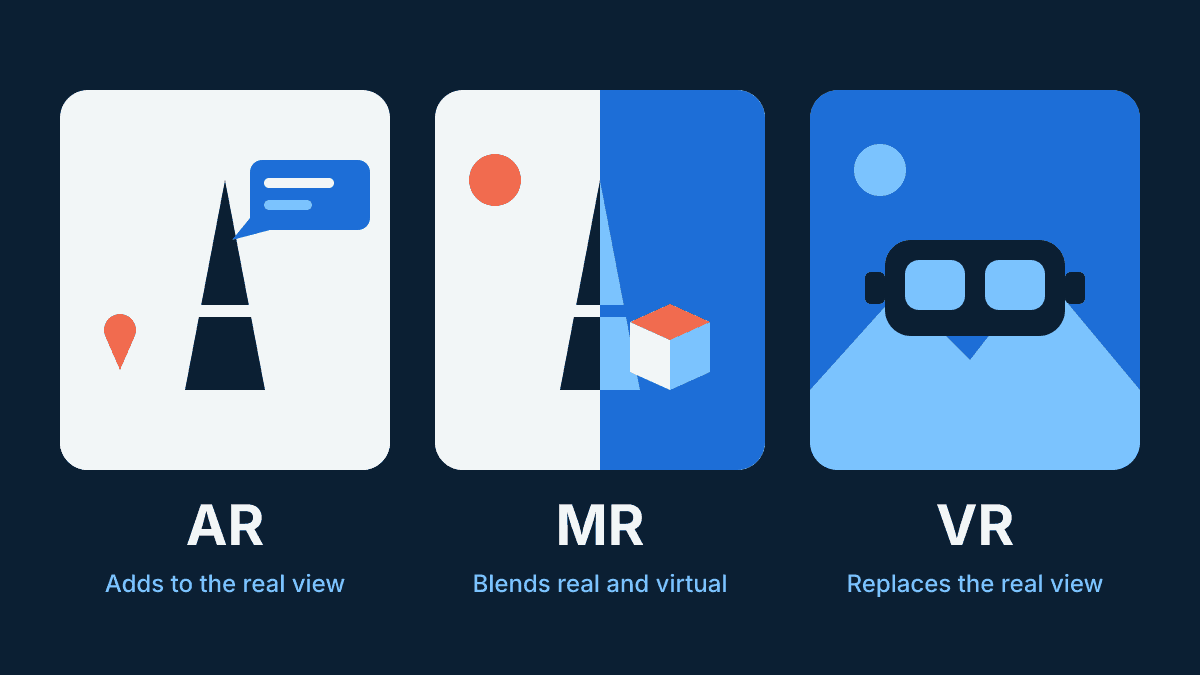
Augmented reality (AR) adds digital content to the place you are standing in. Virtual reality (VR) replaces that place with another one. Mixed reality and XR are umbrella terms that suppliers use loosely. Knowing which is which tells you whether a product is meant for visitors on site or for people who have not arrived yet.
Key takeaways
- AR is for being there: it works with the real place, usually on the visitor’s own phone.
- VR is for not being there: it shows a place through a headset, mostly before a trip or instead of one.
- The labels are used inconsistently: a 2022 paper in Computers in Human Behavior found that academics and professionals do not agree on the terms, so ask a supplier what the product does.
In this guide
The four terms
- Augmented reality (AR). Digital content, such as an arrow, a label or a 3D model, laid over a live view of the real world.
- Virtual reality (VR). A fully virtual environment, computer-generated or filmed, that replaces what the viewer sees.
- Mixed reality (MR). On the reality-virtuality continuum used in research, the middle ground between the real world and a fully virtual one. A 2022 systematic review in Information Technology & Tourism places AR and augmented virtuality under this umbrella, with VR at the fully virtual end.
- XR. A catch-all for all of the above. The authors of the 2022 Computers in Human Behavior paper argue that the X is best read as a placeholder for any new reality format, not as an abbreviation of “extended”.
What each is used for in travel
- AR, on site. Walking directions, sign and menu translation, and labels or reconstructions at museums and heritage sites. Start with augmented reality in travel, then AR navigation and AR in museums and heritage sites.
- VR, before or instead of the trip. Previews of destinations, hotels and ships, and virtual visits for people who cannot travel. Start with virtual reality in travel, then VR for destination marketing and virtual travel from home.
- Either, behind the scenes. Staff training is covered in VR training for travel and hospitality staff.
Why the terms get confused
The confusion is in the research as well as the marketing. The Computers in Human Behavior paper describes inconsistent use of the terms by academics and professionals, and concludes that AR and VR are fundamentally different and should be treated as different experiences. A systematic review in Current Issues in Tourism set out to establish which forms of VR and AR tourism researchers had studied and where the gaps were, because that picture had not been drawn systematically.
For a travel organization, the practical point is that a 360-degree video on a phone, a headset experience and a phone app that labels a ruin may all be sold under the same word. They need different equipment and suit different moments in a trip.
Questions to ask
- Does the visitor see the real place with content added, or a different place altogether?
- What device does it run on, and who supplies it: the visitor or us?
- Is it meant for people before they travel, while they are here, or after they leave?
Common questions
What is the difference between AR and VR in travel?
AR adds digital content to the real place and is used on site, usually on a phone. VR replaces the real place with a virtual one and is used mostly before a trip or instead of one, usually through a headset.
What does XR mean?
XR is a catch-all for AR, VR and mixed reality. One 2022 paper argues the X should be read as a placeholder for any new reality format, not as an abbreviation of “extended”.
Sources
- Rauschnabel P A, Felix R, Hinsch C, Shahab H, Alt F. What is XR? Towards a Framework for Augmented and Virtual Reality. Computers in Human Behavior, 2022.
- Systematic review of immersive technology use in tourism. Information Technology & Tourism, 2022.
- Yung R, Khoo-Lattimore C. New realities: a systematic literature review on virtual reality and augmented reality in tourism research. Current Issues in Tourism, 2019.
Related guides from the ARVR Network
- AR vs VR vs Mixed Reality in Healthcare: What Is the Difference? (ARVRhealth.com)
- AR vs VR vs Mixed Reality in Education: What Is the Difference? (ARVRedtech.com)