Last reviewed: November 2026. This guide is general information. Check any product or service against your own organization’s needs before you commit to it.
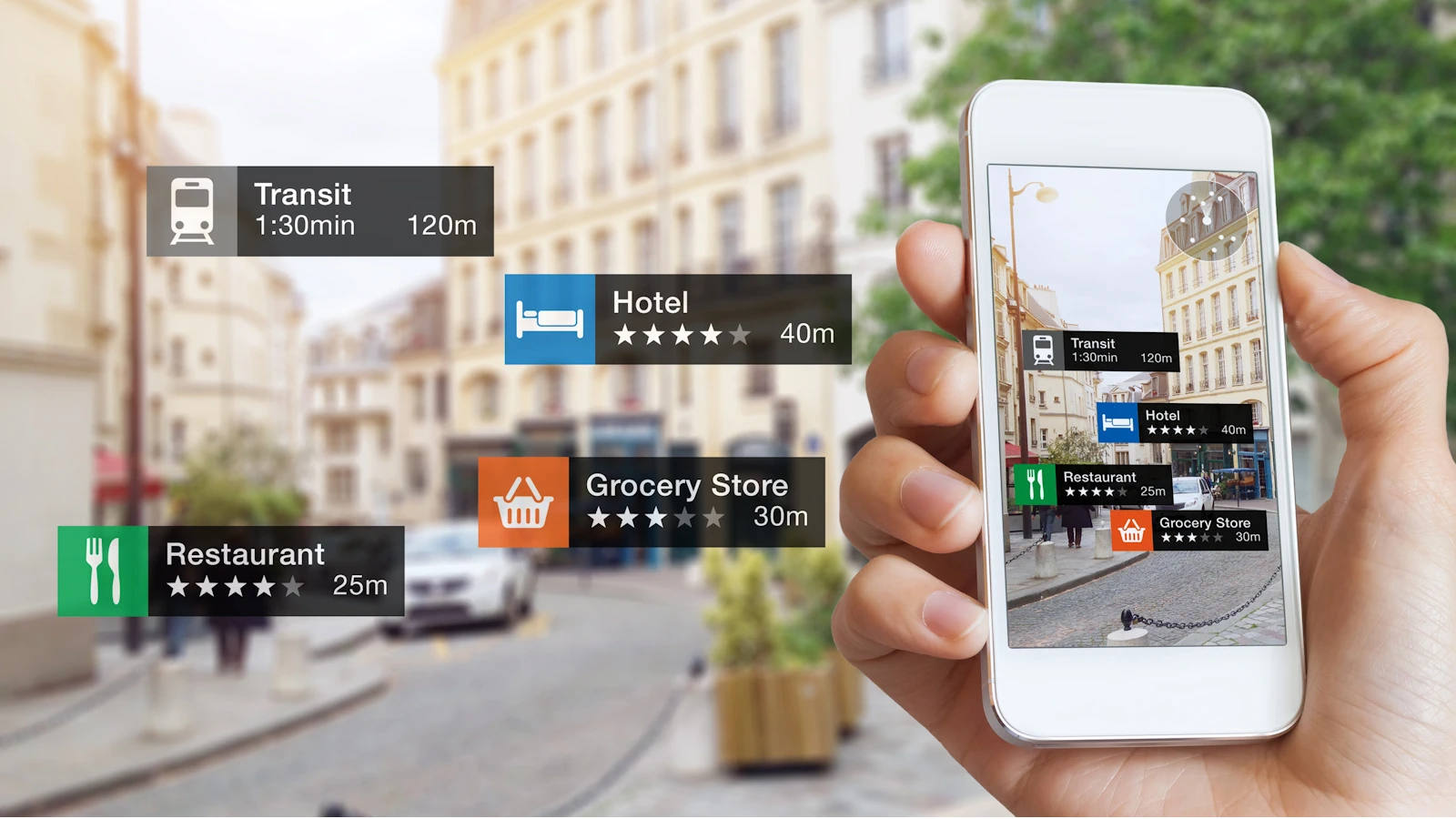
Augmented reality (AR) adds digital content, such as a label, a route or a 3D reconstruction, to a live view of the real place. In travel it usually runs on the visitor’s own phone, on site. Reviews of the research list clear benefits and real risks, and show that most studies so far ask whether people will accept the technology, not what it does for a visit.
Key takeaways
- What the research covers: a systematic review of AR tourism research found five research clusters, with the main one focused on whether users accept AR.
- Museums: a meta-analytic review of AR and VR in museum learning found positive effects on achievement (0.45) and on visitors’ perceptions (0.59).
- Benefits and risks: a review of 33 studies identified nine themes of benefit and eight themes of risk, including privacy and security, technical and service failure.
- A known gap: acceptance studies show people are willing to use AR. They say less about whether it improves a visit or brings people back.
In this guide
How AR differs from VR
- Augmented reality keeps the visitor in the real place and layers digital content over it. A visitor might point a phone at a ruin and see how the building once looked.
- Virtual reality replaces the real place with a computer-generated or filmed scene, usually through a headset. See our guide to virtual reality in travel.
The difference matters for travel. As the authors of one review put it, VR could act as a substitute for a trip, while AR works with the real environment and so depends on the visitor being there.
What the research shows
- What has been studied. A systematic review in Tourism and Hospitality Research looked only at AR in the tourism literature. It identified five research clusters, with one predominant cluster on user acceptance of AR, commonly using the technology acceptance model.
- Museum learning. A 2022 meta-analytic review in Educational Research Review reviewed 51 studies of AR and VR in museum learning and pooled 17 of them. It found significant positive effects on academic achievement (effect size 0.45) and on perceptions (0.59), and that mobile devices were used more often than headsets.
- Benefits. A 2024 review in the Journal of Science and Technology Policy Management coded 33 primary studies dated January 2010 to February 2024. It found nine themes of benefit, among them differentiated travel experiences, more effective marketing and greater tourist engagement.
- Presence. A 2022 meta-analysis in Tourism Management examined AR and VR together and confirmed presence as the core feature of both in tourism.
Risks the reviews list
The same 2024 review found eight themes of risk in the AR tourism literature: physical, privacy and security, social, service failure, technical, psychological, managerial, and gaps in information and knowledge. For an organization, the practical reading is short.
- Physical. People looking at a screen are not looking where they walk.
- Privacy and security. AR apps use the camera and often the visitor’s location.
- Technical and service failure. An app that will not load, or a site with no signal, leaves the visitor with less than a printed sign would.
Limits of the evidence
- Acceptance is not impact. The largest body of AR tourism research asks whether people would use the technology. That does not show it makes a visit better.
- Museum results are about learning. The museum meta-analysis measured achievement and perceptions, and combined AR with VR. It does not tell a venue what AR does to visitor numbers or spending.
- Small reviews. The reviews of AR in tourism cited here rest on a few dozen studies each, so their conclusions are provisional.
Questions to ask
- What does the AR content show that a sign, guidebook or audio guide cannot?
- Will it work on visitors’ own phones, with the signal available on site?
- What data does the app collect, and who holds it?
- What does a visitor get if the app fails or they choose not to install it?
Common questions
How is augmented reality used in travel?
Mostly on site, on the visitor’s own phone: labels and reconstructions at heritage sites and museums, and directions and information in cities. Unlike VR, it works with the real place and depends on the visitor being there.
Does AR improve the visitor experience?
The evidence is strongest for learning in museums, where a meta-analytic review of AR and VR found positive effects on achievement (0.45) and perceptions (0.59). Most other AR tourism research measures whether people accept the technology, which is a weaker test.
What are the risks of AR for visitors?
A 2024 review found eight themes of risk in the research: physical, privacy and security, social, service failure, technical, psychological, managerial, and gaps in information and knowledge.
Sources
- Liang L J, Elliot S. A systematic review of augmented reality tourism research: What is now and what is next? Tourism and Hospitality Research, 2021.
- Zhou Y, Chen J, Wang M. A meta-analytic review on incorporating virtual and augmented reality in museum learning. Educational Research Review, 2022.
- Jalilvand, Ghasemi. Augmented reality technology in tourism and hospitality research: a review from 2010 to 2024. Journal of Science and Technology Policy Management, 2024.
- Fan X, Jiang X, Deng N. Immersive technology: A meta-analysis of augmented/virtual reality applications and their impact on tourism experience. Tourism Management, 2022.
Related guides from the ARVR Network
- Augmented Reality in Healthcare: Where It Works and What the Evidence Says (ARVRhealth.com)
- Augmented Reality in Education: What the Research Shows (ARVRedtech.com)