Last reviewed: November 2026. This guide is general information. Check any product or service against your own organization’s needs before you commit to it.
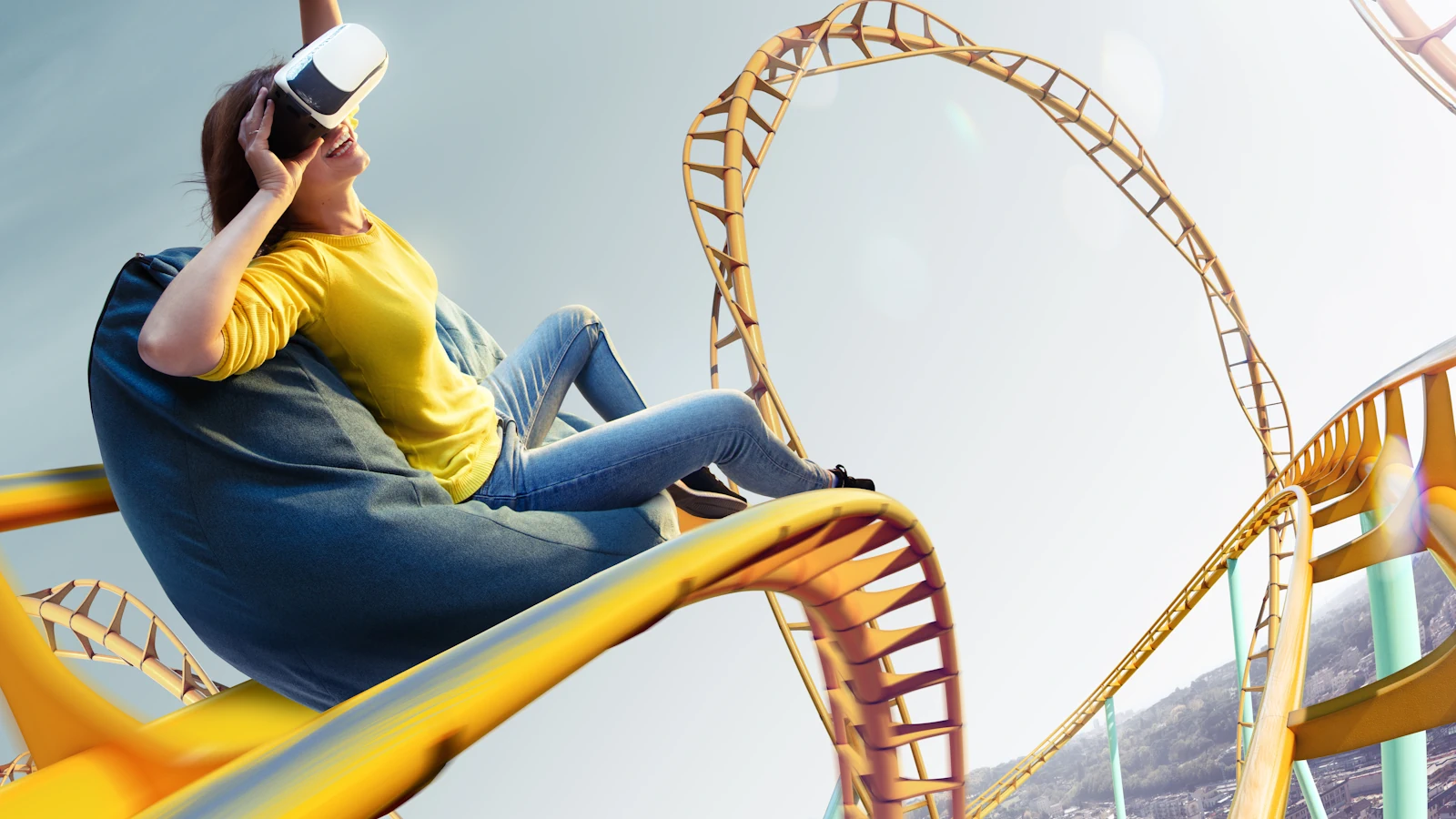
Theme parks have added virtual reality to rides, most visibly by putting headsets on roller coaster riders. The published research is thin but points one way: visitors who feel more present in the virtual scene rate the whole park visit more highly and say they are more likely to come back. The studies rely on what visitors remember and report.
Key takeaways
- Presence and the wider visit: among 396 visitors who had ridden a VR roller coaster, a stronger sense of presence went with a better overall park experience and higher intention to revisit and recommend.
- Content matters: a study of Korean theme parks argues that familiar, nostalgic animation content strengthens the VR experience.
- Sickness is common: a meta-analysis found many headset users report sickness symptoms, influenced by content and movement.
In this guide
What the research shows
- VR roller coasters. A 2019 study in Tourism Management collected data from 396 theme park visitors who had ridden a VR roller coaster in the previous twelve months. It found the sense of presence in VR had a positive effect on visitors’ overall theme park experience and on their intentions to revisit and to recommend the park.
- Nostalgia. A 2022 paper in the Journal of Promotion Management looked at VR added to attractions in Korean theme parks. It suggests that pairing VR with animation content visitors already feel attached to gives a stronger emotional connection, presence and immersion, and proposes this as a way to encourage return visits.
- Sickness. A 2020 meta-analysis in Frontiers in Human Neuroscience found sickness scores from headset use were relatively high across content types, and were affected by visual stimulation, movement and exposure time. A ride adds real motion on top.
Limits of the evidence
- Recall surveys. The roller coaster study asked people about a ride taken up to a year earlier. It shows a link between presence and satisfaction, not that VR caused extra visits.
- No comparison group. It surveyed only people who rode the VR version, so it cannot say whether the same ride without headsets would have scored differently.
- Little on AR. The studies cited here are about VR. We did not find comparable evidence for AR in parks to include in this guide.
Questions to ask
- How much longer does loading take when every rider needs a headset fitted and cleaned?
- Can riders choose the ride without the headset?
- What is the plan for riders who feel unwell?
- Is the content tied to stories our visitors already care about?
For the wider evidence on presence, see virtual reality in travel.
Common questions
Does VR improve theme park rides?
In a survey of 396 visitors who had ridden a VR roller coaster, those who felt more present in the VR scene rated the overall park experience higher and were more likely to say they would return and recommend it. The study did not compare against the same ride without VR.
Do VR rides cause motion sickness?
Headset use often does. A 2020 meta-analysis found relatively high sickness scores across content types, affected by visual stimulation, movement and exposure time.
Sources
- Wei W, Qi R, Zhang L. Effects of virtual reality on theme park visitors’ experience and behaviors: A presence perspective. Tourism Management, 2019.
- VR and Nostalgia: Using animation in theme parks to enhance visitor engagement. Journal of Promotion Management, 2022.
- Saredakis D, Szpak A, Birckhead B, Keage H A D, Rizzo A, Loetscher T. Factors Associated With Virtual Reality Sickness in Head-Mounted Displays: A Systematic Review and Meta-Analysis. Frontiers in Human Neuroscience, 2020.
Related guides from the ARVR Network
- Privacy, Safety and Ethics of AR and VR in Healthcare (ARVRhealth.com)